On a first birthday, a toy needs to work for a child who has just reached twelve months. A label that starts at eighteen months can be useful for a later occasion. The best first birthday gifts for toddlers have something the child can use now, or they have a distinct purpose for the family as they remember the milestone.
Ask the caregivers what the child keeps returning to, including simple switches, sounds, board books, or objects they can put in and take out. A larger present should have a home after the celebration. Look at the ages and set contents before buying.
The gifts below include separate options for floor play, supervised movement, shared reading, and one keepsake for the adults. Read choosing gifts people appreciate for help choosing around the family’s priorities and the space they actually have.
Quick Answer
- Hape Pound & Tap Bench — Best Overall for a First Birthday Music Activity: Choose the bench when the child already watches or joins in when someone makes a sound.
- Fisher-Price Little People Caring for Animals Farm — Best for Beginning Animal Pretend Play: Choose the farm when caregivers have room for an animal playset and welcome that kind of play.
- Playskool Poppin’ Pals — Best for Repeating a Simple Action: Choose Poppin’ Pals for a child who enjoys discovering what happens when they move a button or switch.
Comparison Table
| Product | Best For | Age and Format | Setup or Storage |
|---|---|---|---|
| Hape Pound & Tap Bench | Best Overall for a First Birthday Music Activity | E0305; 12+ months; slide-out xylophone | Tapping can be loud in a shared room |
| Fisher-Price Little People Caring for Animals Farm | Beginning Animal Pretend Play | Listed 1+ years; sound playset with figures | Larger gift is likely to sit beside a basket |
| Playskool Poppin’ Pals | Repeating a Simple Action | 9+ months; mechanical pop-up activity toy | Repeated popping creates audible clicks |
| Fisher-Price Baby’s First Blocks and Rock-a-Stack | Sorting and Stacking | Factory bundle labeled 6+ months; shape sorter and ring stacker | Pieces need gathering after use |
| VTech Sit-to-Stand Learning Walker | a Requested Push-Behind Activity Toy | Orange push-behind model; 9 months to 3 years | Wheeled use needs a suitable area and supervision |
| The Very Hungry Caterpillar Board Book | Illustrated Lap Reading | Eric Carle; die-cut board book edition | May duplicate a familiar book |
| Dear Zoo | Lift-the-Flap Play with a Caregiver | Rod Campbell lift-the-flap board book | Flaps need gentle handling |
| Duck & Goose Colors | Pointing at Colors Together | Tad Hills board book; publisher ages 0–3 | Adults should guide the reading |
| Pioneer DA-200SF Photo Album | Best as a Family Keepsake | Black leatherette; 200 pockets for 4 × 6-inch prints | Printed photographs must be supplied separately |
1. Hape Pound & Tap Bench — Best Overall for a First Birthday Music Activity

The Hape Pound & Tap Bench E0305 starts at twelve months. It combines a pounding bench with a slide-out xylophone, giving the caregiver two ways to begin. A child can tap with help or watch the balls move through the bench. The same gift works in short play sessions.
Choose a suitable floor or table area and follow the maker’s directions for the mallet and loose pieces. Consider the sound during a party and whether a family would rather open it at another time. The product works without an electronic sound mode.
Pros
- Bench and keyboard offer separate ways to play
- Hammer and balls make a cause-and-effect activity
- Keyboard slides out for tapping
- Wooden instrument is reusable
- Plays without batteries
Cons
- Tapping can be loud in a shared room
- Requires appropriate play space and supervision
Choose the bench when the child already watches or joins in when someone makes a sound. It offers a first-birthday activity adults can share with a newly one-year-old without expecting the child to perform for the guests.
To buy this product, click here.
2. Fisher-Price Little People Caring for Animals Farm — Best for Beginning Animal Pretend Play

Fisher-Price Little People Caring for Animals Farm starts at age one in the selected listing. The barn and animal figures give a caregiver material for a short game of opening a door, making an animal sound, or moving a character into the barn. The set has places to play and needs room.
Check which figures and sound functions come in the exact package. A larger box can overwhelm a small play area and may duplicate a farm set already picked. Learn how the family feels about sounds, and leave the pieces under caregiver control.
Pros
- Farm setting supports pretend play
- Included animals provide recognizable characters
- Doors and play areas offer actions
- Sounds add another activity
- Can be shared with a caregiver
Cons
- Larger gift is likely to sit beside a basket
- Requires battery and sound preference checks
Choose the farm when caregivers have room for an animal playset and welcome that kind of play. On the birthday, begin with one action and a couple of figures so the child can explore without having to understand an entire pretend story.
To buy this product, click here.
3. Playskool Poppin’ Pals — Best for Repeating a Simple Action

Playskool Poppin’ Pals begins at nine months and offers several switches on one base. Each door gives the child something to open and reveal. A caregiver can demonstrate one movement, close the door again, and let the child try. Mechanical controls keep the gift usable without charging.
It makes a clicking noise and is focused on a small group of actions. Ask if the family already has a similar pop-up toy. Set it on a stable play surface, and decide where the base will be stored when not in use.
Pros
- Different switches open different doors
- Characters can be revealed repeatedly
- No batteries needed
- One base holds moving parts
- Works for short floor sessions
Cons
- Repeated popping creates audible clicks
- Limited activity once switches become familiar
Choose Poppin’ Pals for a child who enjoys discovering what happens when they move a button or switch. A caregiver can share that interest on the birthday with one door at a time and return to other controls later.
To buy this product, click here.
4. Fisher-Price Baby’s First Blocks and Rock-a-Stack — Best for Sorting and Stacking

The Fisher-Price Baby’s First Blocks and Rock-a-Stack bundle has an age label of six months and up. The shape sorter and stacker offer two separate activities. A one-year-old may start by emptying the bucket or lifting a ring while a caregiver demonstrates matching or stacking.
Check for duplicates since both toys are common. The bucket can hold the shapes afterward, and the stacker needs its own spot. The pair works for a child who likes taking apart a simple arrangement and repeating it, with the caregiver supervising according to the packaging.
Pros
- Includes two complementary activities
- Shape lid supports matching
- Bucket can hold the blocks
- Ring stacker offers another play pattern
- No batteries needed
Cons
- Pieces need gathering after use
- Check whether the family already has either toy
Choose the pair when the child likes filling and emptying nearby containers. Start with the bucket and add the stacker when the child is ready for another activity, leaving the sorting goal flexible during the celebration.
To buy this product, click here.
5. VTech Sit-to-Stand Learning Walker — Best for a Requested Push-Behind Activity Toy
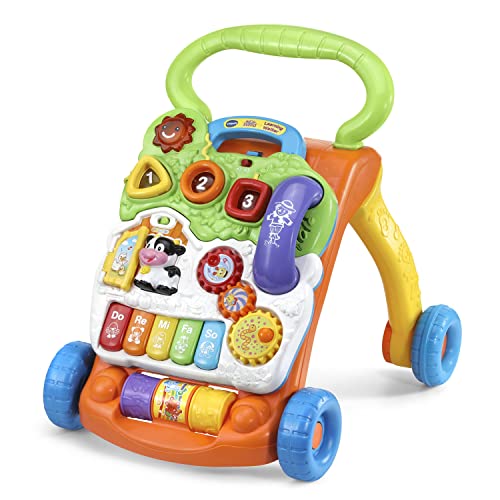
The orange VTech Sit-to-Stand model uses a detachable activity panel with a push-behind frame. The maker markets the model for nine months to three years. The panel lets the caregiver set up play on the floor first, and the frame can be used later if the family wants it.
This is a push-behind model, and use of the wheeled frame depends on the child’s readiness and a suitable area with caregiver supervision. Confirm the family has an appropriate space away from stairs and wants a toy with sound. Check batteries and follow the included directions.
Pros
- Activity panel detaches for floor use
- Wheeled frame offers a later mode
- Several controls give varied interactions
- Panel can be used before push play
- Orange configuration is easy to identify
Cons
- Wheeled use needs a suitable area and supervision
- Check battery and sound requirements
Choose the VTech when caregivers specifically want its removable panel and push-behind format. Let them decide when to use the frame and which mode suits their space, so the present fits the child’s readiness at the time.
To buy this product, click here.
6. The Very Hungry Caterpillar Board Book — Best for Illustrated Lap Reading

The compact board edition of The Very Hungry Caterpillar gives a caregiver a story to share without any equipment. Die-cut details and large illustrations offer something for the child to notice. On a birthday, a caregiver can read a few pages at a time or choose one favorite picture.
Check whether the family has this edition already. The board size serves a different purpose from a larger hardcover display copy. Put the giver’s message on a separate card if the caregivers want to hand the book around for regular use.
Pros
- Board pages support repeated shared handling
- Die-cut pages give the child details to explore
- Illustrations cue a read-aloud
- Compact edition adds little shelf bulk
- Can be enjoyed as a caregiver-led ritual
Cons
- May duplicate a familiar book
- Board edition format is smaller than a picture-book hardcover
Choose the board edition when the family wants an ordinary story to revisit together after the birthday. Its clearest first use is a short shared reading session that follows the child’s attention instead of expecting everyone to finish the story.
To buy this product, click here.
7. Dear Zoo — Best for Lift-the-Flap Play with a Caregiver

Rod Campbell’s Dear Zoo introduces animals one at a time through its flaps. This gives the adult a simple rhythm and something interactive for a one-year-old to watch or try with help. The selected board edition fits easily in a book basket or bag.
The flaps need gentle handling. Share it with a caregiver who can guide the page and let the child look without needing to open each flap independently. Check which edition the family owns, as there are multiple versions of the story.
Pros
- Flaps give the reader a role
- Animals offer an easy topic for talk
- Short sequence fits a quick read
- Board format suits shared handling
- Small book needs little shelf room
Cons
- Flaps need gentle handling
- The familiar story may already be owned
Choose Dear Zoo when the child enjoys a reveal and the family likes reading animal books together. A caregiver can hold the flap and wait for a response, making each reading useful even when the child looks at only a few pages.
To buy this product, click here.
8. Duck & Goose Colors — Best for Pointing at Colors Together

Duck & Goose Colors is a Tad Hills board book with a publisher age range of zero to three. It gives the adults a way to talk about colors while the child looks at the illustrations. That age guidance includes the first birthday and the familiar board format requires little setup.
This is an early concept book. Use it for pointing and talking rather than treating it as a quiz. Check whether the family already has a favorite color book and choose this one around the child’s interest in its pictures and characters.
Pros
- Color concepts provide a clear way in
- Board pages suit shared handling
- Pictures offer something to point at
- Can be read in short sittings
- No accessories or batteries required
Cons
- Adults should guide the reading
- May overlap a color book already owned
Choose Duck & Goose Colors for a child who pauses to look or point during lap reading. Leave an inscription on a separate card and allow the child to choose which picture to stay with when the family reads it.
To buy this product, click here.
9. Pioneer DA-200SF Photo Album — Best as a Family Keepsake

The Pioneer DA-200SF holds up to two hundred four-by-six-inch prints, with space for captions and a photo on the cover. It gives the caregivers a place for the birthday and first-year photographs if they enjoy printed albums. The product is for the adults to handle.
Ask which images they want and whether they would like anyone to print them. Leaving it empty can be appropriate if they prefer to select the contents later. A couple of approved prints are enough to begin without expecting the whole album to be completed after the party.
Pros
- Clear pockets hold individual prints
- Memo areas provide space for names and dates
- Cover frame accepts a chosen photograph
- Book format can be stored rather than displayed
- No app or powered screen is needed
Cons
- Printed photographs must be supplied separately
- Filling a large album can become an unwanted task
Choose the Pioneer album if the family has said they want to save printed photographs from the first year. Offer to make a few approved prints, with every decision about who can see or copy them left to the caregivers.
To buy this product, click here.
Buying Guide
Use twelve months as the reference point
Check the manufacturer’s minimum on the precise toy, even for products sold as toddler toys. Give a later-use item only when the caregivers specifically request it and have a place for it. A first birthday is easier to shop for when the gift can be useful immediately.
Match space and sound to the household
A stacker needs floor room. A farm requires storage for a barn and figures. A music bench or electronic panel introduces sounds. Ask about the available space, and make a plan for large items at a venue away from home.
Let caregivers decide how to set up toys
A child may enjoy only one activity on the first day. A caregiver can choose when to introduce extra parts and how to use equipment with moving pieces. Follow the model’s guidance and protect younger siblings from pieces they should not handle.
Choose a book the household will read
Simple illustrations, a flap, or a point-and-name format work differently during a shared reading session. Check titles the family already has and ask what the child likes to see. A board book is easy to transport and can be the main gift.
Preserve memories with permission
A family album has a purpose when the caregivers already want prints. Ask before adding images, especially pictures involving other children. To make a small present feel specific to the child and the occasion, see choosing a meaningful gift.
FAQ
Can I give a toy labeled eighteen months and up?
A child turning one is twelve months old. Select something with a suitable age for immediate use, or ask if the caregivers want a gift for later.
Which toy works without batteries?
The selected Hape bench, Poppin’ Pals, and sorting and stacking bundle are mechanical. Check the package for instructions and which pieces are included.
Should I buy a walker for a child who has begun pulling up?
Ask the family about their preferences and the maker’s guidance. A push-behind toy still requires a suitable supervised area. The detachable panel in this guide offers a separate floor-use option.
Can a first birthday gift be for the parents?
An agreed photo album can be a meaningful family keepsake. It has a different role from a toy for the child. Confirm the family actually wants printed photos.
What is easy to hand over at a party?
A board book is compact and ready for a caregiver to use later. If you choose a larger farm or activity toy, check where the family will put it after the party.
How can I help the child use the present on the day?
Offer simple shared time and follow the caregiver’s lead. One sound, picture, or opening motion may be enough for a first session.
Final Verdict
Start with the Hape bench for an age-appropriate music activity, the farm for a family that wants animal play, or Poppin’ Pals for a child who likes repeated actions. Check the exact product’s labeled age at purchase.
A good first-birthday gift leaves caregivers room to choose how and when they use it. Select a book, toy or approved keepsake that fits a specific part of the family’s life.